 05 Aug, 2026
 Industry News Industrial Use
The fastest way to vet a CNC supplier is to ask specific process, inspection, and capacity questions before you send a purchase order — not after parts show up wrong. A shop that hedges on tolerances, can’t explain how it inspects features, or dodges questions about capacity is telling you something important, even if the quote looks great. The 12 questions below are the ones experienced buyers actually ask, and what the answers usually reveal about whether a shop can run your job well.
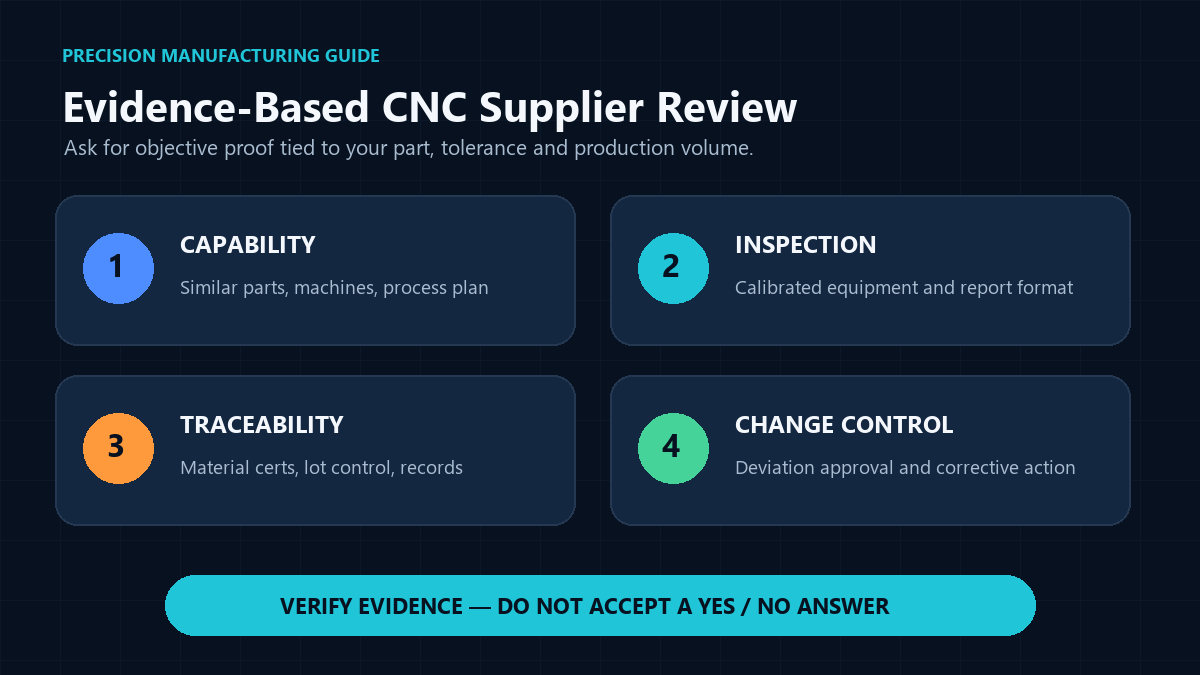
Every shop will tell you they can hold ±0.001″. Fewer shops can tell you what that means for a 3-inch bore in 316 stainless versus a thin aluminum bracket wall. Push past the generic answer and ask about the specific feature on your drawing.
A supplier worth working with will ask you back: is that tolerance functional, or just a habit carried over from an old drawing? That question alone tells you they understand how tolerance requirements actually drive cost and process selection. If nobody on the other end questions an unusually tight callout, they’re either not reading the drawing carefully or they’re planning to quote it loose and deal with it later.
Visual inspection and a set of calipers is fine for non-critical brackets. It is not fine for a shaft that mates with a bearing at a 0.0005″ interference fit. Ask what equipment they use — CMM, optical comparator, height gauge, thread gauges — and whether inspection is tied to the specific tolerances on your drawing or just a general once-over.
Also ask what documentation you get back. Some buyers only need a certificate of conformance. Others need a full dimensional report with actual measured values for every GD&T callout. Don’t assume; ask, and confirm the shop can generate what your program actually requires.
This is less about bragging rights and more about diagnosing experience with your specific geometry. A shop that mostly runs simple turned shafts may struggle with a deep-pocket aluminum housing that needs 5-axis access. A shop heavy on prototypes may not have the fixturing discipline needed for a 500-piece repeat order with consistent tolerances part to part.
For example, a robotics company sourcing a multi-axis machined gripper housing should ask specifically about parts with similar undercuts and tight positional tolerances — not just general machining capability. Browsing a supplier’s case studies or application examples before the call saves time on both sides.
Bad drawings happen. What matters is what the supplier does about it. A shop that quotes and machines without asking a single clarifying question is either extremely confident or not paying attention — and it’s usually the second one.
Ask how they handle missing GD&T datums, ambiguous surface finish notes, or tolerances that don’t match the part function. A supplier that flags issues before cutting metal is protecting your budget, not just theirs. This matters even more on first-run prototype orders, where a misread drawing can mean a scrapped part and a lost week.
Stocked aluminum 6061 and mild steel usually mean faster turnaround. Specialty alloys, certain plastics, or specific stainless grades often get ordered per job, which adds lead time you need to plan around. Ask directly, especially if you’re comparing 6061 versus 7075 aluminum or need a less common plastic.
Also ask about mill certifications and lot traceability if your industry requires it — aerospace and medical buyers in particular should confirm this upfront rather than assuming it’s included.
Machining is often just step one. Anodizing, passivation, bead blasting, powder coating — these usually happen at outside vendors, and coordinating them adds time and risk if the supplier doesn’t manage it well.
Ask whether finishing is handled in-house or outsourced, and how they quality-check parts after they come back from a finishing vendor. A part that passes dimensional inspection before anodizing can come back out of tolerance if the coating thickness wasn’t accounted for. Review surface finishing options together with your supplier before finalizing the drawing note.
Every shop scraps parts occasionally. The honest ones tell you that upfront instead of pretending it never happens. Ask what their process is for nonconforming parts — do they scrap and remake automatically, or do they call you first? Do they track root cause, or just move on to the next job?
This question also reveals whether the shop treats machining defects as a normal part of process control or as something to hide. You want a supplier that catches problems internally, not one whose customers catch them.
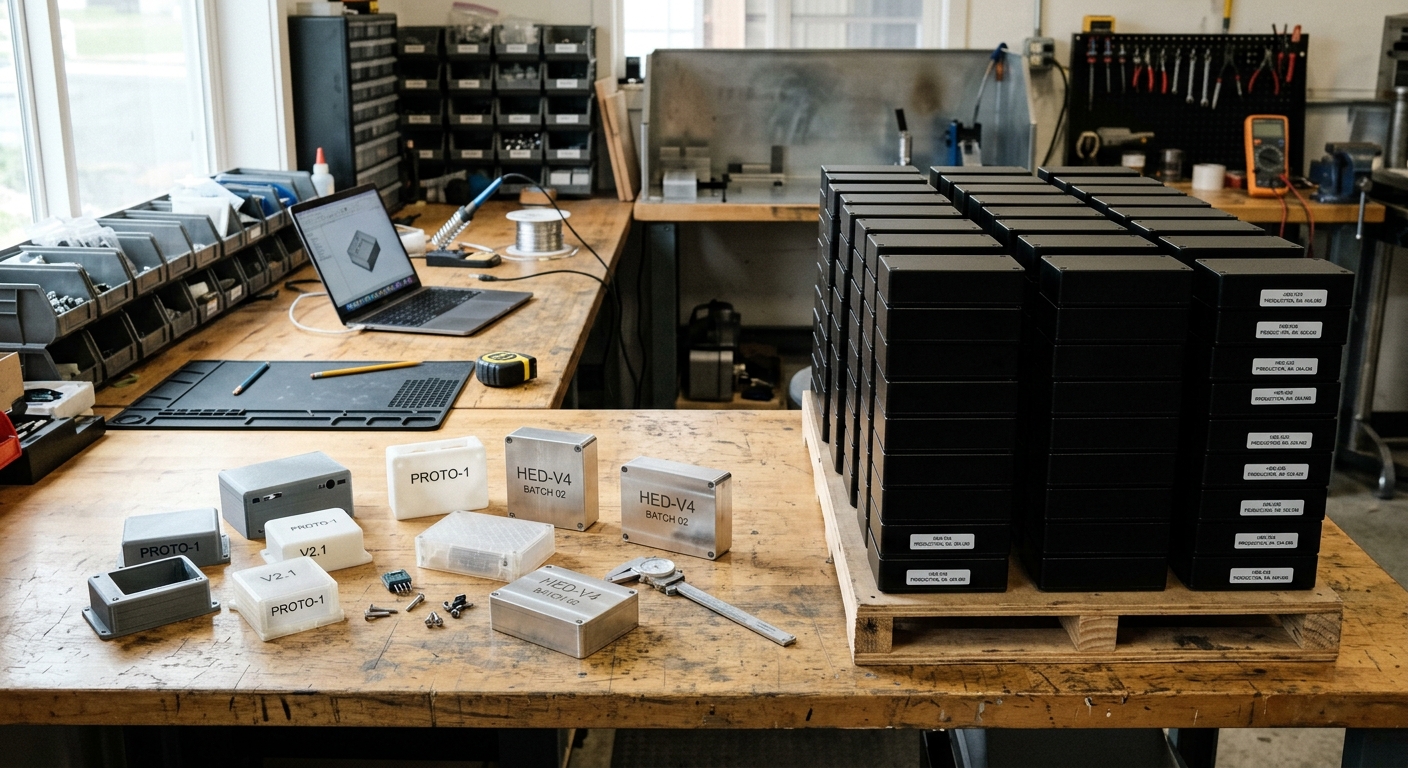
A lot of projects start with five prototype units and end up needing 2,000 units a year later. Ask whether the supplier can scale with you, or whether you’ll need to re-source once you move past prototypes. Switching suppliers mid-program means re-qualifying the part, which costs time nobody budgeted for.
For instance, a startup developing an enclosure for a new sensor device might run three iterations of 10 units each before locking the design, then need 300 units a quarter once it launches. A supplier who only handles rapid prototyping — or only handles high-volume production — forces a supplier switch at the worst possible moment. Ask about this before you place the first order, not after.
Ask for a specific number, not a range that spans three weeks. Then ask how often actual delivery matches the quoted date. A supplier that’s honest about occasional delays and explains why is more trustworthy than one that promises perfection.
Lead time also depends heavily on your part’s complexity, quantity, and whether it needs outside finishing — so a fair supplier will explain what’s driving the number instead of just giving you a date with no context.
This is a question most buyers never ask, and it’s one of the most revealing. A shop running near full capacity may quote a fair price but struggle to hit the lead time. Ask directly what their current machine loading looks like and how a rush order would fit in.
A supplier who’s transparent about being busy — and tells you honestly if your timeline is tight — is more useful to you long-term than one who says yes to everything and quietly pushes your job to the back of the queue.
This is where a lot of cost gets saved or wasted. A supplier that just quotes what’s on the drawing, without flagging a deep pocket that needs a special tool or a thread depth that’s borderline for the material, is leaving money on the table for you to find out later.
Ask if they do DFM feedback as a standard part of the quoting process. Reviewing design-for-manufacturability guidance together with a quote often reveals cost reductions of 10-30% through small geometry changes — sharp internal corners softened to a standard radius, wall thickness adjusted, or a tolerance relaxed on a non-critical feature.
This sounds basic, but it matters more than most buyers expect. Is there a dedicated point of contact, or do you get routed to a general inbox every time? Ask what happens if a shipment is delayed, a part fails inspection after delivery, or you need an engineering change mid-run.
A supplier with a clear point of contact and a defined process for handling issues is far easier to work with than one that only communicates well when things are going smoothly. Check their company background and how long they’ve been running production programs, not just prototype jobs.