 10 Jul, 2026
 Industry News Design & Manufacturing

There’s no single right answer — cut threads (tapping or thread milling) work for most metal parts, formed threads (roll tapping) give you stronger threads in high-volume fastener applications, and inserts (Heli-Coils, heat-set inserts) rescue soft materials or parts that get assembled and disassembled repeatedly. The real decision comes down to your material, hole geometry, load requirements, and how many times that thread gets used. Pick the wrong method and you’ll find out the hard way — usually when a thread strips during final assembly.
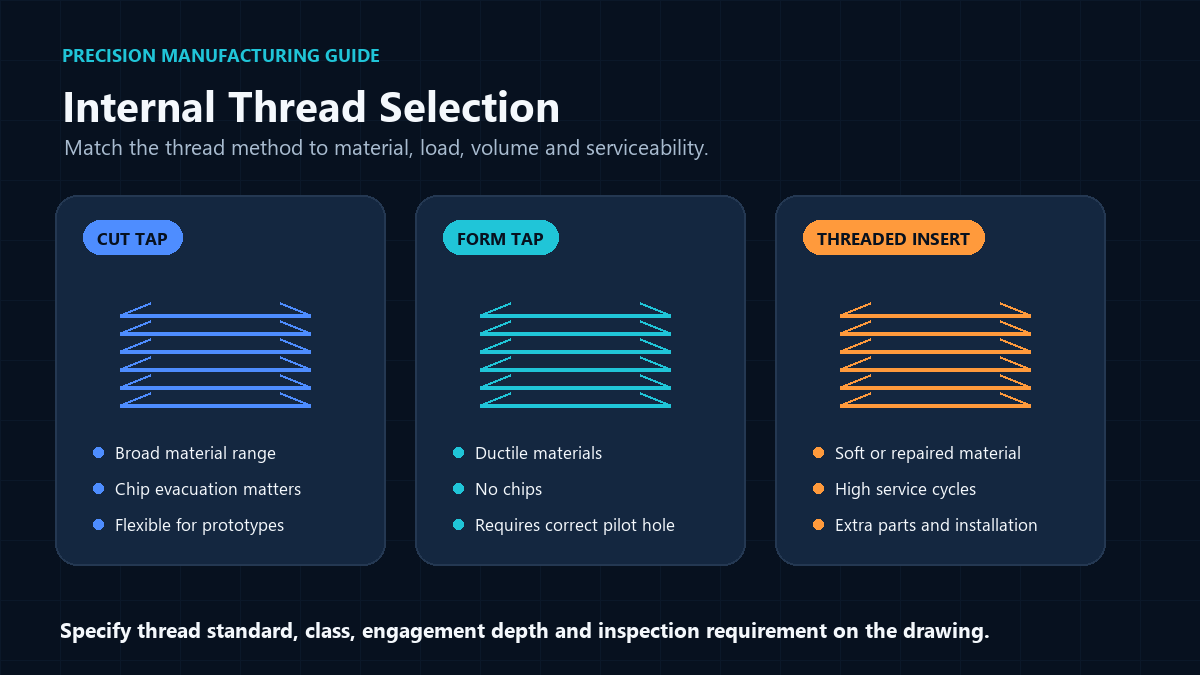
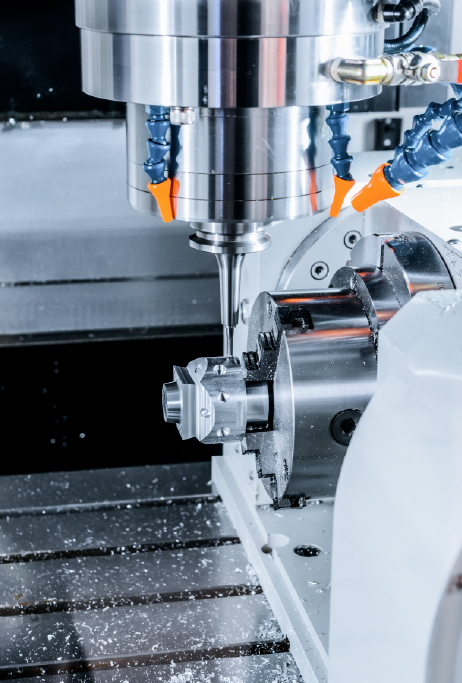
Most threads in machined parts are cut — either tapped with a tap or thread-milled with a single-point tool on the CNC machine. Cutting removes material to form the thread profile, which is why it works on almost any machinable material: aluminum, steel, stainless, titanium, even brass and plastics in a pinch.
Tapping is faster and cheaper for standard hole sizes, especially in production runs where a tap can cycle through hundreds of holes before it needs replacing. Thread milling, on the other hand, gives you more control — better for large diameters, blind holes where chip evacuation is tricky, or hard materials like titanium where a tap is prone to breaking off inside the hole (which, trust us, ruins your day and the part).
The weak point is material shear strength. In soft aluminum alloys like 6061, a tapped M3 hole in a thin wall can strip after just a few torque cycles. If your part sees repeated fastener removal — a lid that gets opened for maintenance, say — cut threads directly in soft metal are often the wrong call. That’s usually when engineers reach for an insert instead, which we cover further down.
Thread rolling doesn’t cut material away — it displaces it, pushing metal outward to form the thread profile. This creates continuous, unbroken grain flow along the thread, which measurably increases fatigue strength and resistance to stripping compared to a cut thread of the same size.
The catch: rolling only works well on ductile materials. Steel and stainless roll beautifully. Cast iron, brittle plastics, or highly hardened alloys will crack or flake instead of deforming cleanly. Rolling also requires a pre-sized blank diameter that’s tighter than what tapping needs, and the tooling investment is higher — which is why you mostly see roll-formed threads on high-volume standard fasteners (bolts, screws) rather than custom low-volume machined parts.
For a one-off prototype or a run of 50 brackets, rolling almost never makes economic sense. For 50,000 fasteners going into an automotive assembly, it’s the obvious choice.
Inserts solve a specific problem: your base material is too soft, too brittle, or too thin to hold a reliable thread on its own. Heli-Coils (wire-wound inserts) go into metal parts and are usually the fix when a tapped hole in aluminum or magnesium has already stripped, or when you want steel-grade thread strength in a lightweight housing. Heat-set inserts (brass, often knurled) go into injection-molded or machined plastic parts — nylon, ABS, POM, even PEEK — where cutting threads directly into the polymer would crack or creep under load over time.
A customer building a drone chassis in machined 7075 aluminum kept stripping the M2.5 mounting holes for the camera gimbal — the wall was only 2mm thick, no room for a deep tapped thread. Switching to a stainless steel Heli-Coil insert let them keep the thin wall while getting a thread that could survive dozens of field disassemblies without wear. That’s the insert’s whole value proposition: it decouples thread strength from base material strength.
The tradeoff is cost and process complexity — you’re adding a secondary operation (insert installation, sometimes with heat or ultrasonic tooling for plastics) and the insert itself is a purchased component with its own lead time.
Small holes and cut threads have an uneasy relationship. Below M3 or so, tap breakage risk climbs fast, and thread milling becomes the safer (if slower) option because you’re not relying on a single fragile tool bottoming out in a blind hole. Above M12 in tough materials, thread milling again wins — it’s easier to control chip load and finish quality on large-diameter threads than to fight a tap through that much material.
Blind holes deserve extra attention regardless of method. Chips have nowhere to go, and a clogged flute on a tap is one of the most common causes of broken taps in production. If your design allows it, a through-hole is always easier and cheaper to thread reliably than a blind one — something worth flagging early when you’re reviewing design for CNC machining choices with your machine shop.
If you remember one thing from this article, make it this: material properties dictate the threading method far more than the application does. Stainless steel and titanium can generally handle cut or milled threads without issue — they’re tough enough to resist stripping under normal torque. Aluminum is the gray zone: fine for cut threads in thick sections, risky in thin walls. Plastics and soft cast metals are where inserts stop being optional and start being necessary.
Our materials page breaks down which alloys and polymers we run most often, and our guide on machining stainless steel covers related surface and tooling considerations that also affect thread quality in that material.
Cut threads win on low-volume flexibility — no dedicated tooling, easy to reprogram, cheap to prototype. Formed threads win on high-volume fastener production where the upfront die cost amortizes over tens of thousands of parts. Inserts sit in an odd middle ground: they cost more per hole than either cutting or rolling, but they can be the only option that actually survives the application, which makes the “cheaper” alternatives a false economy if the part fails in the field.
A good rule of thumb we use when quoting: if a customer’s assembly drawing calls for a fastener to be removed and reinstalled more than a handful of times, we flag it for an insert conversation before cutting a single thread.
Thread class (2A/2B, 3A/3B for UN threads, or the metric 6H/6g equivalents) determines how tight the fit is between mating parts. Tighter classes reduce backlash but increase the risk of galling, especially in stainless-on-stainless assemblies without lubrication. This ties directly into broader part tolerancing — if you’re unsure how tight your threads actually need to be, our post on understanding tolerances is a good place to start before locking in a callout that’s tighter (and pricier) than necessary.
Don’t forget that surface finishing operations can affect thread fit. Anodizing adds a few microns of oxide layer that can bind a previously free-spinning fastener — machinists often need to mask threads or run a tap-clean pass after coating. Plating has a similar effect. If your part goes through any of the processes on our surface finishing page, flag the threaded features so the shop accounts for buildup before final inspection.